


Shuaijun Liu (George)

I am a Ph.D. student at The Hong Kong University of Science and Technology (Guangzhou), supervised by Prof. Ningxin Su in NEBULIS Lab.

My research focuses on Embodied Intelligence, Vision-Language-Action Models, Robotic Manipulation, World Models, Reliable Decision-Making, and Efficient Inference for autonomous agents in physical environments. I am especially interested in Distributed Model Deployment, Replanning, and Multi-Agent Collaboration for embodied and autonomous systems.


Education
  • The Hong Kong University of Science and Technology (Guangzhou)
    The Hong Kong University of Science and Technology (Guangzhou)
    Sep. 2025 - Jun. 2028
  • Boston University
    Boston University
    M.S. in Computer Science
    Sep. 2023 - May 2025
  • Hong Kong Baptist University
    Hong Kong Baptist University
    B.S. in Statistics and Data Science
    Minor in Computer Science
    Sep. 2019 - Jun. 2023
Experience
  • Amazon
    Applied Scientist Intern, New York
    Jul. 2024 - Oct. 2024
Honors & Awards
  • China Scholarship Council (CSC) Full Scholarship for Ph.D. Study
    2025
  • Outstanding Graduation Thesis
    2023
  • National Second Prize and Guangdong First Prize, China Undergraduate Mathematical Contest in Modeling
    2022
  • Meritorious Winner (First Prize), Mathematical Contest in Modeling (U.S. undergraduate competition)
    2022
News
2026
Our work HeteroTac-Lift (Empirical Lift Admission via Heterogeneous Bilateral Tactile Servoing and Risk-Budgeted Compliance) is accepted by IROS 2026. Paper coming soon.
Jun 20
2025
Completed M.S. study in Computer Science at Boston University.
May 01
Selected Publications
View all publications
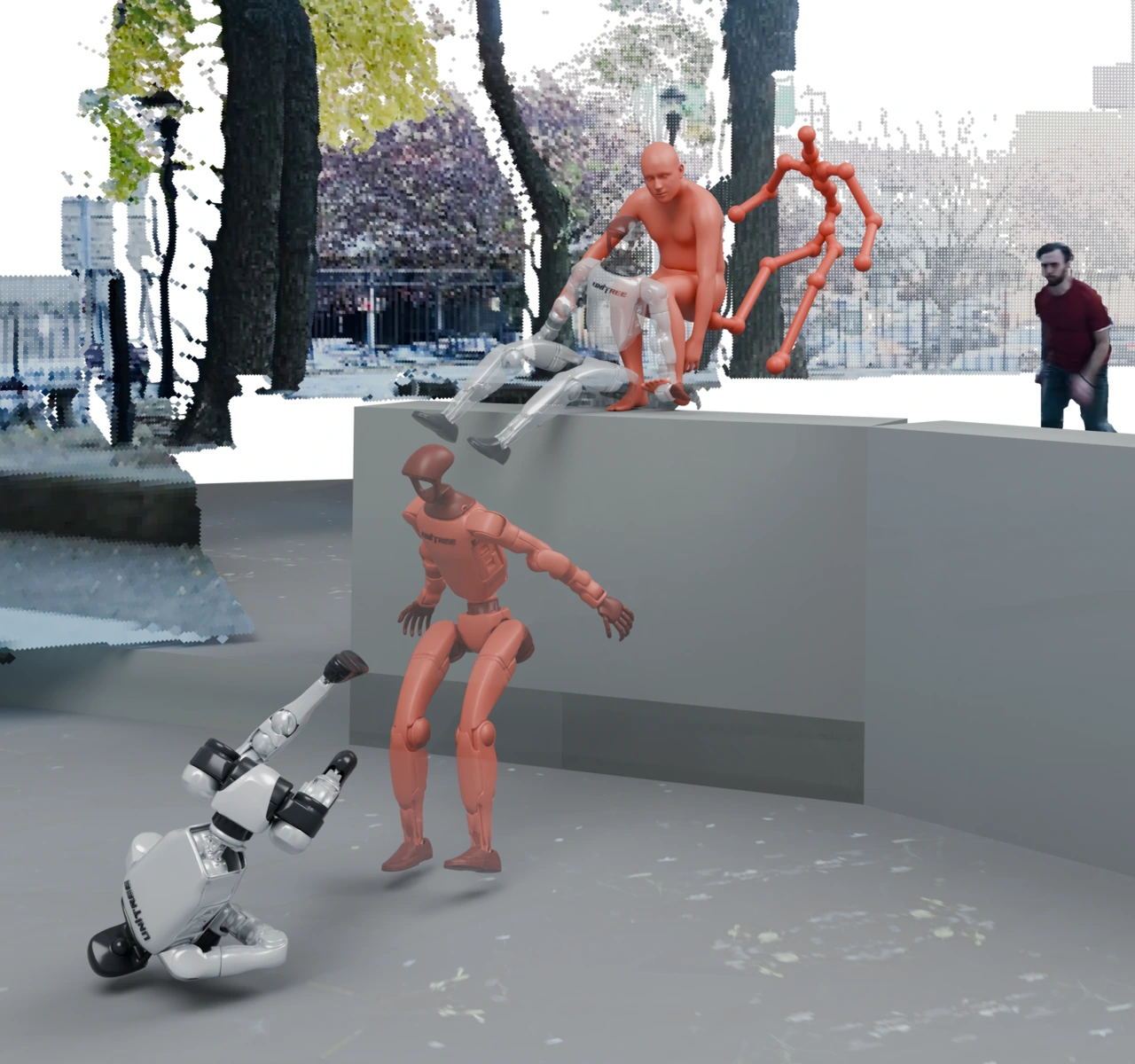
MimicX: Policy-in-the-Loop Supervision Refinement for Video-Driven Humanoid Motion Tracking

Shuaijun Liu, Chenglong Zhang, Xuhao Liu, Feiyang You, Yifan Liao, Shuyang Hao, Chaozhe Zhang, Chengyu Wu, Zhen Sun, Ningxin Su#

arXiv preprint 2026

Uses policy execution feedback to refine supervision for video-driven humanoid motion tracking. MimicX identifies difficult transitions and affected body regions, adapts tracking objectives and reset curricula, and verifies refinements through repeated rollouts. Across four core video tasks, it reduces body-tracking error by 25.7% and increases robust execution horizon by 255.6% over fixed-reference training.
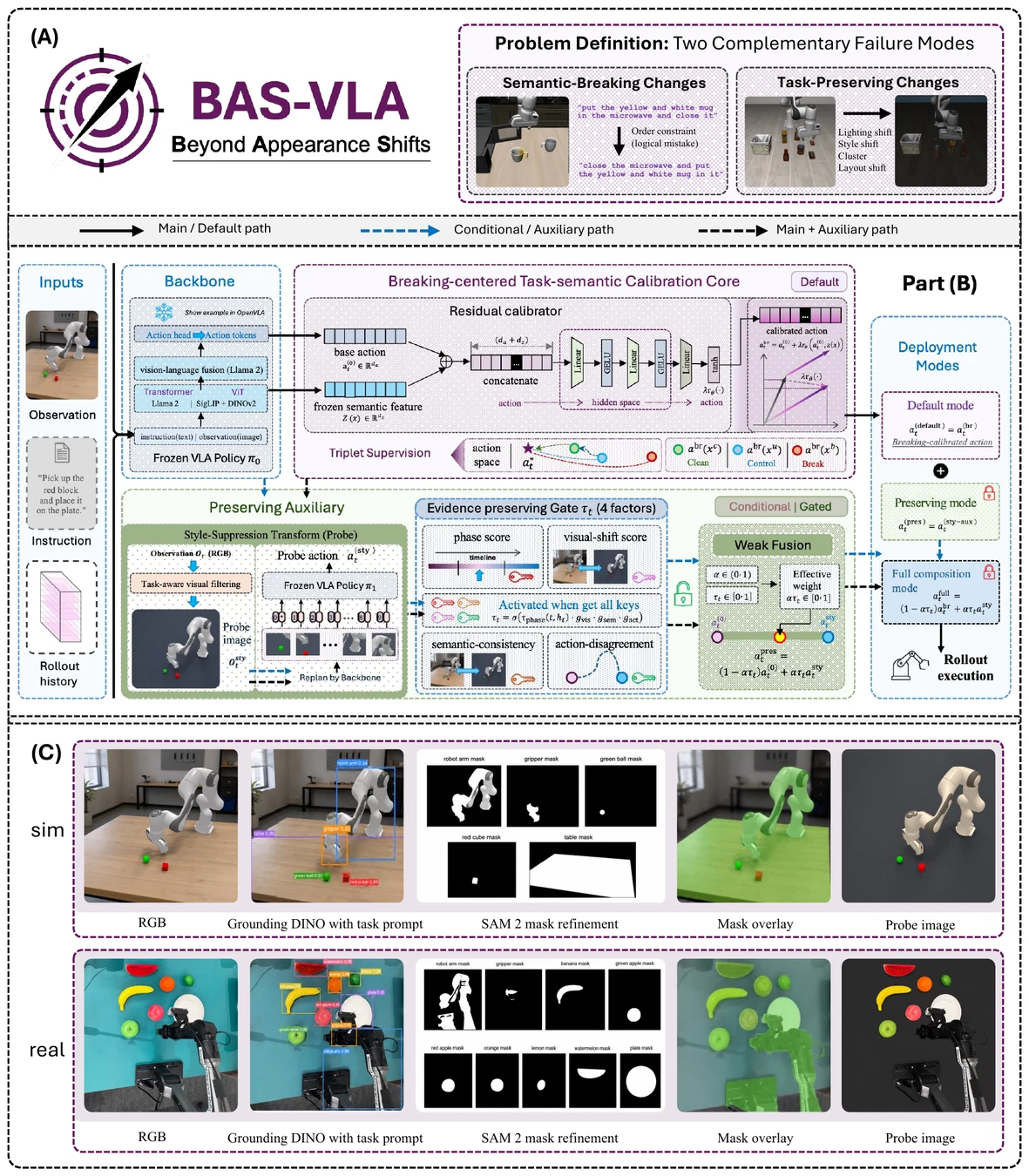
Beyond Appearance Shifts: Task-Semantic Action Calibration for VLA Models

Shuaijun Liu, Feiyang You, Chengyu Wu, Shuyang Hao, Chenglong Zhang, Jingyao Cai, Xingwei Chen, Ningxin Su#

Conference on Neural Information Processing Systems NeurIPS 2026

Calibrates a frozen vision-language-action policy to distinguish changes in scene appearance from changes in task meaning. A semantic calibration core adjusts behavior when the target object or task constraints change, while an evidence-gated auxiliary preserves behavior under irrelevant visual variation. This addresses both unnecessary action drift and continued execution of an outdated task. On the LIBERO-Object Milk-Swap benchmark, BAS-VLA maintains 98.0% clean and 97.5% semantics-preserving success while suppressing the original task after target swaps. Under validated style shifts, it raises success from 42% to 70% without reducing clean performance.

HeteroTac-Lift: Empirical Lift Admission via Heterogeneous Bilateral Tactile Servoing and Risk-Budgeted Compliance

Xingwei Chen, Shuaijun Liu, Feiyang You, Ningxin Su

IEEE/RSJ International Conference on Intelligent Robots and Systems IROS 2026

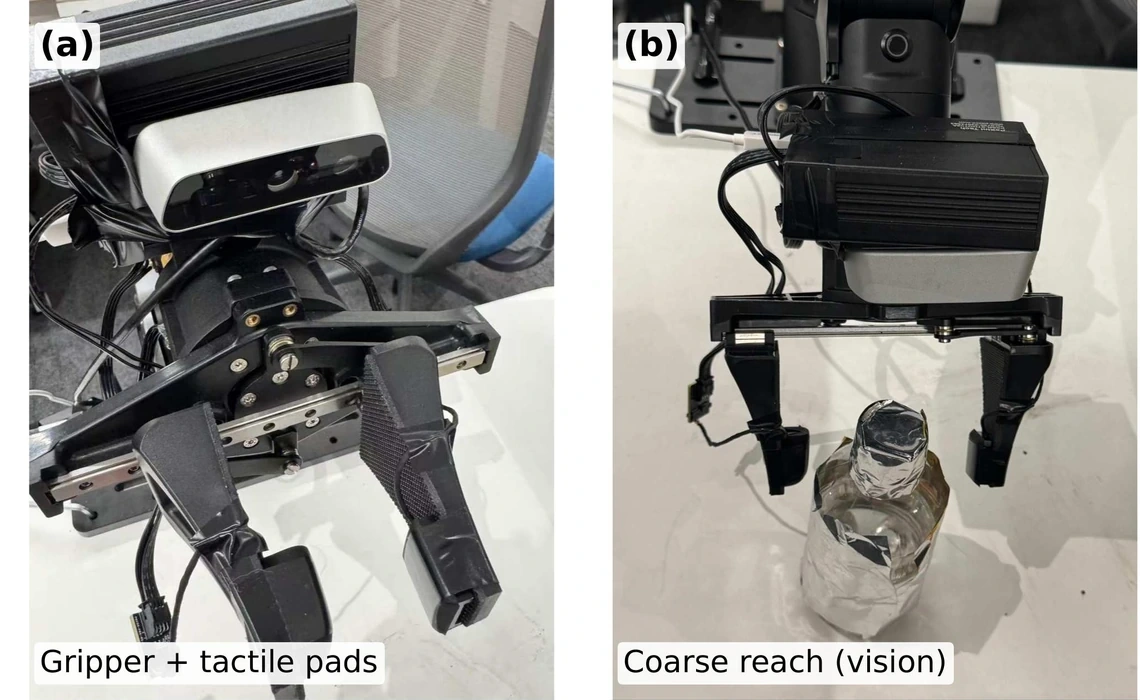
Uses heterogeneous tactile sensors on both gripper jaws to decide when a grasp is ready to lift. Tactile servoing refines contact, risk-budgeted compliance regulates grip force, and a brief micro-lift verifies stability before full lifting. This improves grasping of visually challenging, fragile, and deformable objects while reducing unsafe lift admissions.

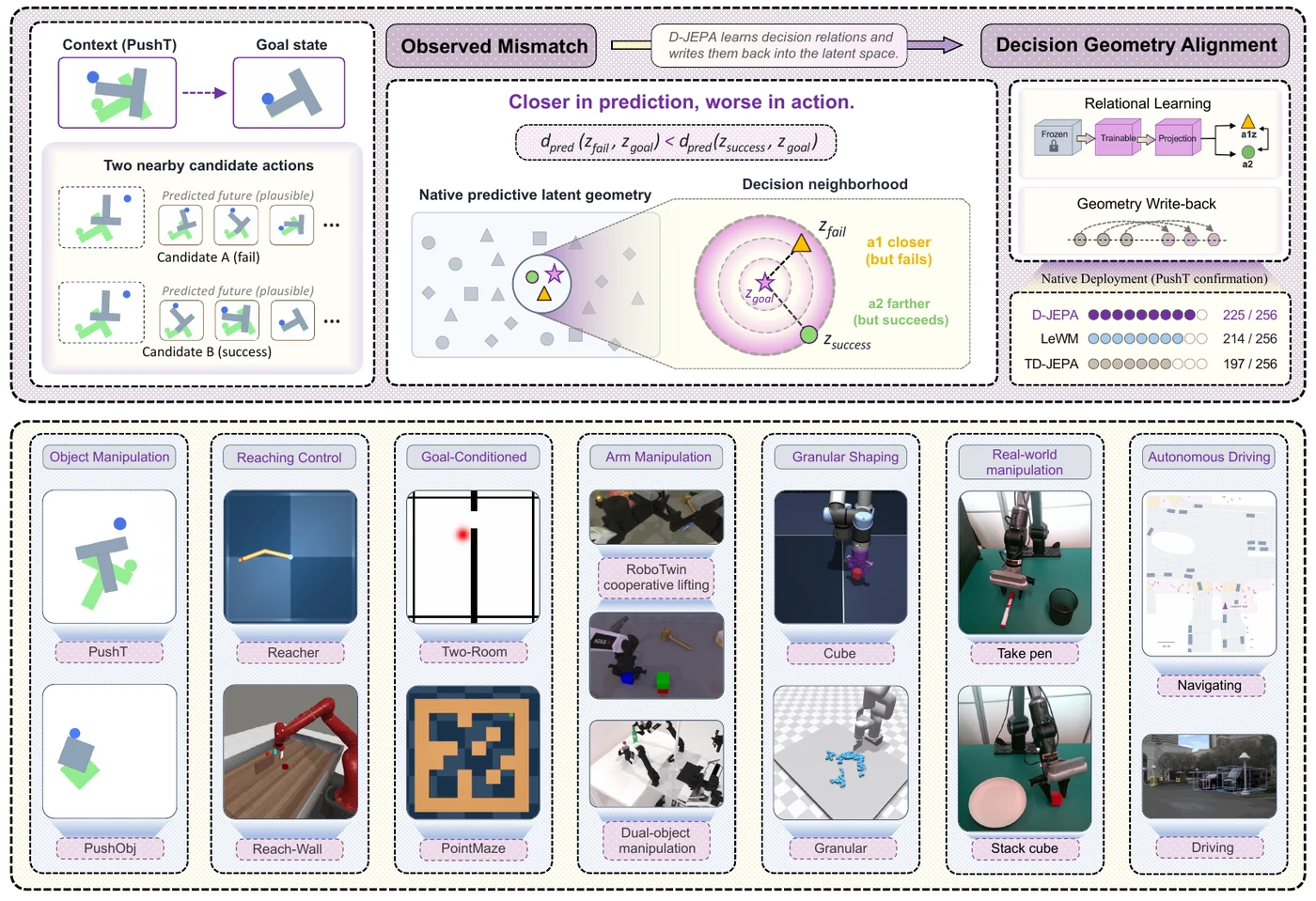
D-JEPA: A Decision-Aligned Latent World Model

Shuaijun Liu, Chengyu Wu, Qifu Wen, Feiyang You, Chenglong Zhang, Shuyang Hao, Xi Lin, Ningxin Su#

arXiv preprint 2026

Aligns latent world-model predictions with executed action outcomes. D-JEPA learns decision-relevant relations among candidate futures and realizes them in representations compatible with native latent-distance planning. Evaluations across control, manipulation, physical robots, and autonomous driving show improved action selection.

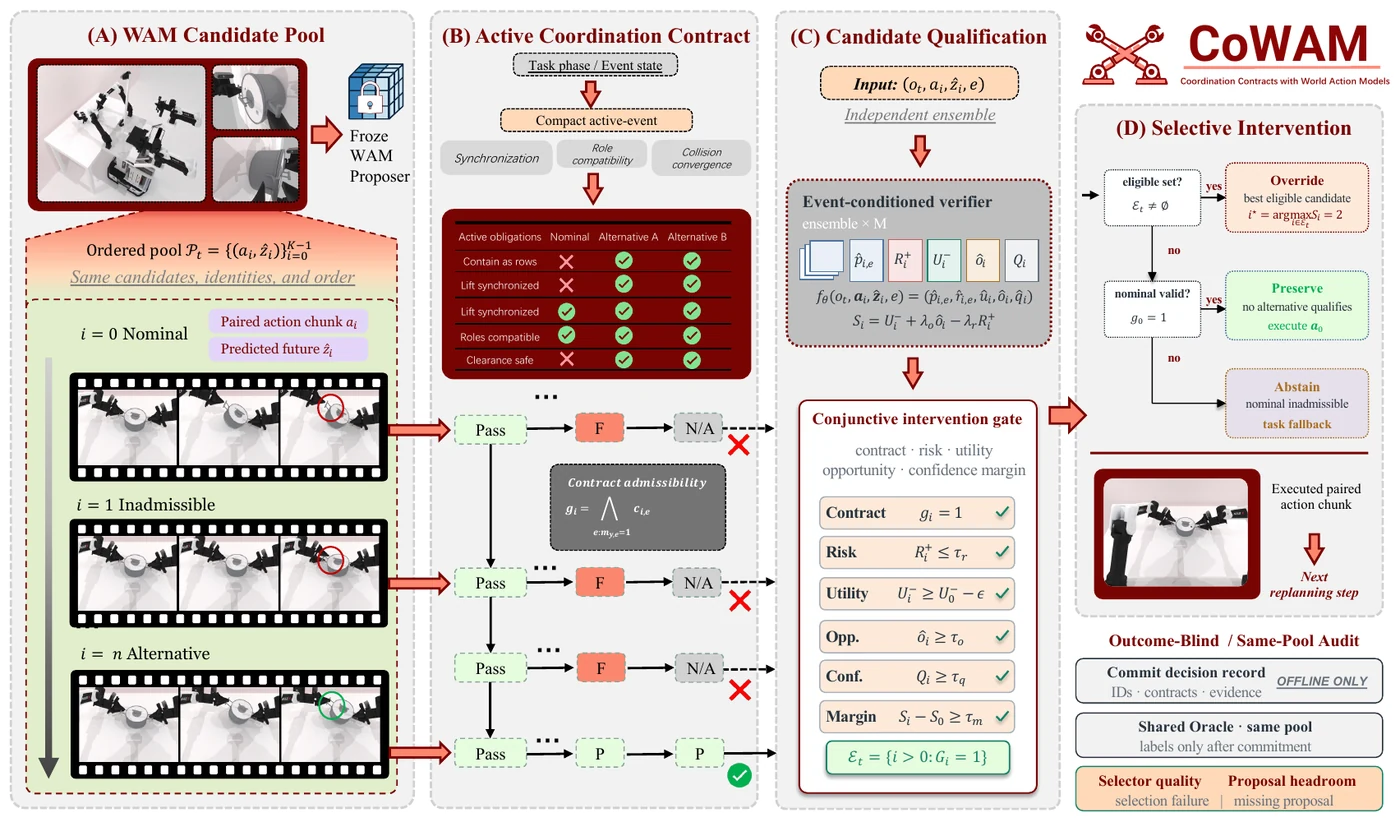
CoWAM: Coordination Contracts for Selective Policy Intervention with WAMs

Shuaijun Liu, Qifu Wen, Shuyang Hao, Qi Luo, Chenglong Zhang, Feiyang You, Chengyu Wu, Ningxin Su#

arXiv preprint 2026

Uses coordination contracts to decide when predicted futures justify a selective intervention in bimanual robot policies. Checks synchronization, role compatibility, and collision risk, retaining the nominal action unless an alternative meets all active constraints and offers a clear, low-risk improvement.

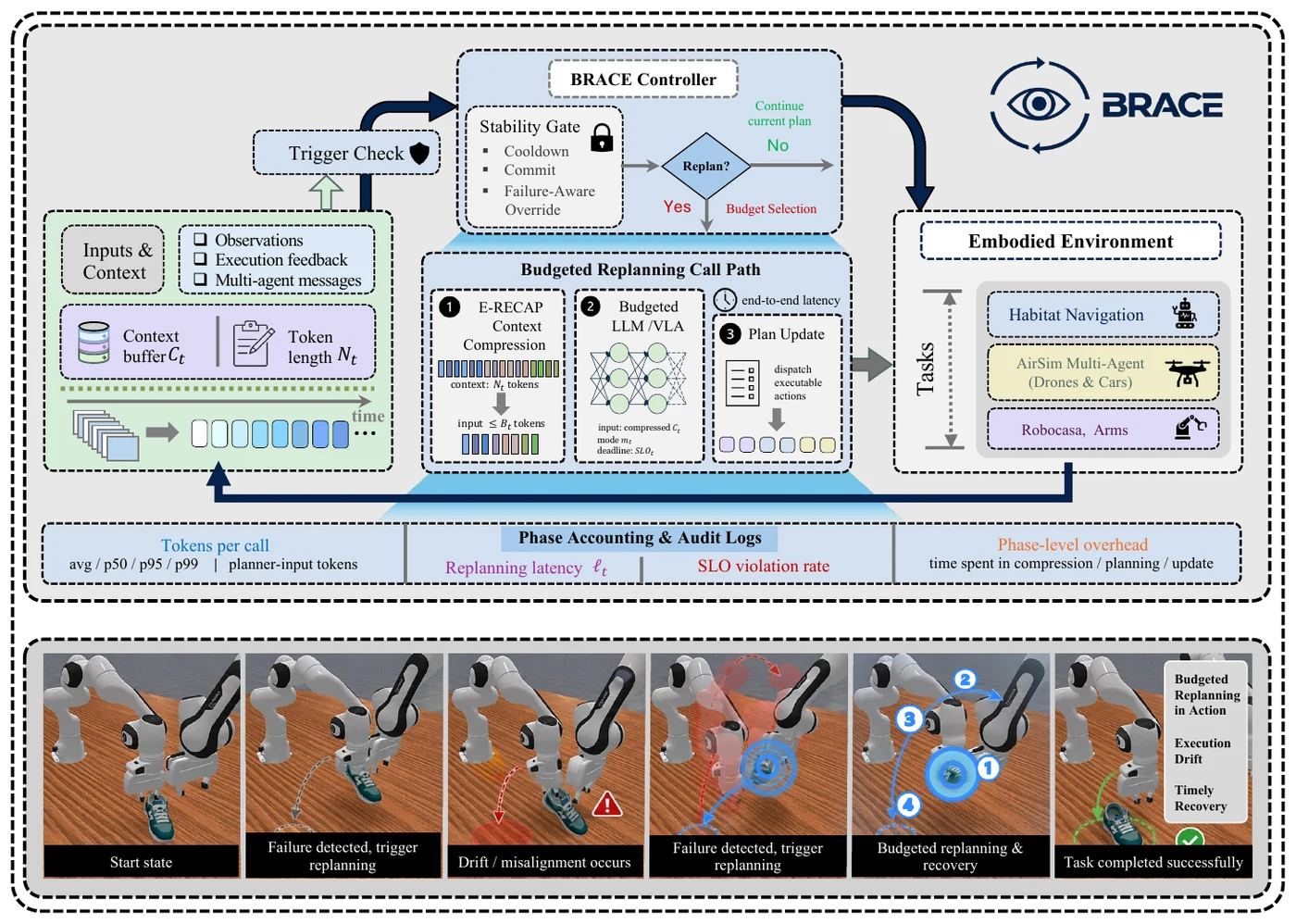
When Replanning Becomes the Bottleneck: Budgeted Replanning for Embodied Agents

Shuaijun Liu, Feiyang You, Xingwei Chen, Ningxin Su#

International Conference on Machine Learning ICML 2026

Studies replanning overhead in long-horizon embodied agents and introduces a budgeted replanning framework with adaptive replanning decisions, token budgets, latency SLOs, and context compression.